
An inevitable yet unforeseen event occurred two years ago on 5 August 2024—the fall and escape of the autocratic ruler Sheikh Hasina. For almost 16 years, the accumulated anger of the oppressed and persecuted people of Bangladesh erupted in a 35-day movement before this.
When the people overcome the fear of an autocrat's oppression, the fall of that ruler becomes inevitable; Bangladesh had reached that point even before 5 August. Therefore, 5 August was just the final episode. Hasina's escape was, in a sense, inevitable. Dictators around the world flee in the face of public outrage. Sheikh Hasina used to boast, "Sheikh Hasina or the Awami League never runs away, has never run away."
It has been two years since Hasina’s escape. Meanwhile, in absentia, she has been sentenced to death in a case for crimes against humanity. Currently, she is in India under asylum. She appears on social media and speaks to foreign journalists. But what might her future hold? Perhaps, the fate of ousted rulers in different countries might provide some insight into what the future may hold for Sheikh Hasina.
Passing away in privacy
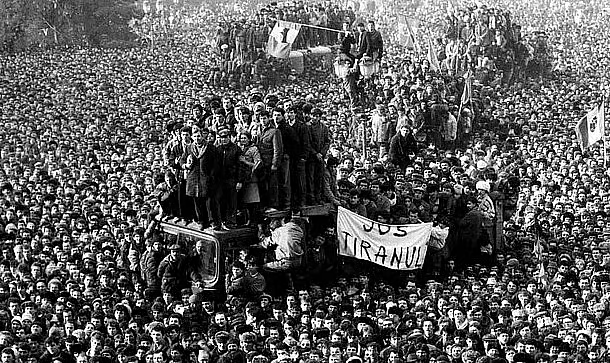
Dictators who are unable to leave the country in the face of public uprisings or try to resist with their supporters, often face brutal assassination. The history of Libya's Muammar Gaddafi dates back to 2011; in 1989, Nicolae Ceausescu of Romania, trying to escape with his wife during an uprising, was caught by protesters and they were killed.
Those who managed to take refuge in other countries, some ended quietly, out of the public eye. After the Islamic Revolution of Iran in 1979, the fugitive Reza Shah Pahlavi, while seeking refuge across six countries in just a year and a half, died in Cairo in poor health. Ferdinand Marcos of the Philippines, after ruling the country for 20 years, was ousted in 1986 and took refuge in Hawaii, United States, where he died in 1989.
In 1990, Chad’s president Hissène Habré was overthrown by a military coup and fled to Senegal, where he died in 2021. The ruler of Tunisia, Zine El Abidine Ben Ali, after facing a public uprising in 2011, took refuge in Saudi Arabia, where he died in 2019. Although they managed to draw the world's attention during their rule, the news of their deaths barely gained significance, with many even unaware of their obsequies.
Inactive life
A large number of fugitive rulers, upon finding asylum in other countries, effectively retire from political life and lead inactive lives in obscurity. Bashar al-Assad of Syria, after being removed from power, took refuge in Russia in December 2024, but since then, nothing has been known about his situation, nor any statements made by him.
The same happened with Afghanistan’s President Ashraf Ghani. When the Taliban took Kabul, he fled to the United Arab Emirates in August 2021. In Ukraine, a mass uprising took place in February 2014; President Viktor Yanukovych fled the country to Russia. It has been said that he lived in the city of Rostov.
However, an investigative report in July this year revealed that he is living in Sochi under an assumed name. It is believed that host countries, for diplomatic reasons, provide asylum to the fugitives under this condition.
Whether these defeated, devastated, and virtually isolated former rulers are interested in returning to politics is also a question. Furthermore, they seem to prefer enjoying a lavish lifestyle funded by the extensive wealth acquired through corruption during their time in power.
Extradition
In most cases, efforts are made to bring these fugitive rulers back to face trial in their home country, but with little success. In 1991, when the backdrop of civil war in Ethiopia caused ruler Mengistu Haile Mariam to flee to Zimbabwe, he was granted political asylum there.
Though the Ethiopian government requested his extradition, Zimbabwe’s government did not comply. After Robert Mugabe's fall from power in Zimbabwe, there were indications that Haile Mariam would be extradited, but this never happened.
In 2000, Peru’s ruler Alberto Fujimori fled to Japan for asylum. Although Peru’s government requested Japan for extradition, it was denied citing his dual Japanese citizenship. However, Fujimori voluntarily traveled to Chile in 2005, where he was detained based on an international warrant issued by the Peruvian government. In 2007, Chile extradited him to Peru.
Kyrgyz President Kurmanbek Bakiyev fled to Belarus in 2010. The Kyrgyz government has been demanding Bakiyev’s extradition since then, but Belarus has not complied; Bakiyev remains there under official hospitality.
Trial
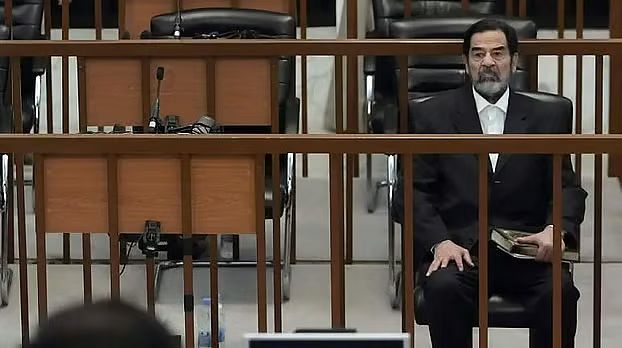
The trial of fugitives in absentia in their home country is generally considered normal. In Ethiopia, the trial against Mengistu Haile Mariam for various crimes, including genocide, started in 1994. At the end of this trial in 2006, the court sentenced him to life imprisonment. In a high court appeal ruling in 2008, his life sentence was increased to a death sentence.
In 2012, Tunisia’s court tried former ruler Ben Ali and his wife in multiple cases, sentencing them to life, 35 years, and 20 years in prison.
Kyrgyzstan's fugitive head of state, Kurmanbek Bakiyev, was sentenced to life imprisonment for his involvement in the killing of protesters during the 2010 uprising.
In 2014, after having to flee to Ivory Coast following a mass uprising, Burkina Faso’s President Blaise Compaoré was found guilty by the country’s court in 2022 for the assassination of his predecessor and sentenced to life imprisonment. Blaise Compaoré has since acquired Ivorian citizenship.
Although not tried in Chad, the trial of President Hissène Habré took place in Senegal, where he had taken refuge. Following persistent efforts by the victims, he was arrested in Senegal in 2013. In 2016, a special court supported by the African union in Senegal found him guilty of war crimes, crimes against humanity, and torture, sentencing him to life imprisonment.
This trial and conviction were the first instance where a former head of state was tried for human rights violations in a court of a country or regional organisation. In Ukraine, former President Viktor Yanukovych was sentenced to 13 years imprisonment on charges of treason by a domestic court in 2019, and another 15 years in 2025 in a separate case.
There are instances of former dictators being tried in person in their home country. Erich Honecker, the head of East Germany, was tried after unification in Germany. After falling from power, a summons against Honecker was issued in 1991, leading him to flee to Moscow in December. He sought refuge in the Chilean embassy and applied for Soviet citizenship. Though he wished to go to Chile, the Chilean government did not agree.

On 29 July 1992, he was forcibly evicted from the Chilean embassy and flown to Berlin. He was arrested at the airport. Meanwhile, charges were framed against him, and his trial with other accused started in November 1992. It became known that he was suffering from cancer and was not expected to live beyond six months. His lawyers appealed for his release on humanitarian grounds. After initially rejecting the appeal, it was accepted. Honecker was released in January 1993 and went to Chile to be with his family, where he died in May 1994.
An example of domestic trial and sentencing is that of Peru's ruler Fujimori. After being extradited from Chile in 2007, he faced trial. In 2009, the Peruvian court sentenced him to 25 years in prison. Although he was released by the Peruvian president in 2017 on humanitarian grounds due to deteriorating health, the court overturned the pardon, sending him back to prison. In December 2023, Peru’s Constitutional Court upheld the presidential pardon. Released from prison, Fujimori died in September 2024.
Return
The return of fugitives to their home country is rare. A recent example is Gotabaya Rajapaksa of Sri Lanka. In July 2022, amid widespread protests, he left the country for the Maldives, staying briefly in Singapore and Thailand. He returned to the country after just 55 days. Leaders of the then-ruling party welcomed him at the airport.
Multiple lawsuits have been filed against Rajapaksa, including one linked to the 2019 Easter bombings at three churches that killed 270 people. It was alleged his government was involved, and he was aware. In June, a court imposed a travel ban on him.
Another notable example is Ali Abdullah Saleh of Yemen. During the 2011 uprising, after an assassination attempt left him injured, he went to Saudi Arabia ‘for treatment’. But in efforts to cling to power, he returned to the country in a few months. Failing to control the situation, he transferred power and stayed in the United States temporarily.
However, after 2014, he formed an alliance with the rebel Houthi faction and actively engaged in military operations against the Saudi-backed Yemeni government. In 2017, a dispute with the Houthi faction arose, leading to his assassination by the Houthis.
None of these outcomes for dictators were predetermined. There was no guarantee these events would unfold exactly the way they did. However, at some point, fugitive autocrats have to accept that they are removed from the political scene; there are examples where attempts to change this have not ended well.
#Ali Riaz is a former vice-chairman of the Interim Government’s National Consensus Commission and a Distinguished Professor in the Department of Politics and Government at Illinois State University, USA.
*The opinions expressed here are the author’s own.
#This article, originally published in Prothom Alo on edition, has been rewritten in English by Rabiul Islam
Courtesy: en.prothomalo.com


